

This is an emotive subject and because of this many people have written about the forthcoming deadline of folic acid fortification. Much of the research you may look at on this subject has papers stating ‘Folic acid deficiency’ which is ridiculous. It should only be written as folate deficiency since no one has a deficiency of synthetic folic acid. It’s akin to saying someone with scurvy has a Sunny Delight deficiency.
You might be wondering why such a move is happening in the UK and why it has already happened in the US, Canada and Australia. Whilst we know that low folate and indeed low B12 can be risk factors for NTD’s it’s especially important to understand that excess folic acid can be harmful to the nervous system and that a safe upper limit hasn’t yet been established.
Some, I’m sure may be angry about what I write here but it’s really important for us to examine, this is what we’ll be looking at:
What bread means to us and the Campaign for real bread
Folic acid and who should steer clear of it
Research into the consequences of folic acid fortification
NTD’s
The blame game
What are the other causes of 1000’s of NTD’s and birth defects that have been ignored for decades?
Sodium valproate and other teratogens
Epilepsy
Bipolar
MTHFR
What bread means to us…
Bread is recognised as one of the most important foods we eat, historically known as the staff of life, it is deeply embedded in British culture.
People feel very strongly about bread, it holds memories for us. If you ask anyone to tell you about the best bread they ate, they’ll probably be able to pinpoint their age, their location even what they were wearing. Describing in detail how that bread made them feel.
If I ask you to imagine the smell of bread or toast at this minute, your mind may be flooded with nostalgic images and that feeling of warmth and comfort that bread can bring.
People don’t like to be mislead about bread.
In June Last year, four supermarkets were misleading customers about ‘freshly baked bread’ when they were ‘rebaking’ or using pre-made third party products . The psychological trick of using of synthetic freshly baked bread scents at the entrance of supermarkets have long been used to manipulate us into buying more.
The franchise SUbway has been in the press because their bread can’t be classed as bread because it contains too much sugar and because they McDonalds, Burger King and others used a ‘yoga mat’ ingredient (dough conditioner) in their bread to make it spongy.
Bread is big business. It’s long been a food stuff attached to a wealth of passion, control, rioting, protesting and adulteration. This continues on with the government making it a vehicle for mass medication by the end of this year…
There have been laws made and repealed about this revered food and what’s happening now brings to mind the 1757 Making of Bread Act which reads : An Act for the due making of bread; and to regulate the price and assize thereof; and to punish persons who shall adulterate meal, flour, or bread. This law was to stop alum, chalk, bones and stones being added to bread by unscrupulous bakers but the allowable ingredients now contained in bread, should come under scrutiny despite some of them them sliding in unchallenged.
If you’re as old as me you will remember the iconic 1973 Ridley Scott Hovis advert with the strap line; ‘As good for you today as it’s always been’. And yet, lifelong customers of Hovis may not be aware of the fact that their loaf now contains soya flour which is classified by the government as a major food allergen.


Despite this fact, soy has found its way into way too many foods promoted as a protein rich food. Yes there will be people arguing that soy has benefits for some, but the question is, why is something marketed to be wholesomely made of wheat, containing something that’s from a highly allergenic bean?
Who is jumping up and down about this? Not the government that’s for sure. But, this fantastic organisation behind the Campaign for Real Bread really care, they want bread that’s for better for us. They state: We define Real Bread as made without chemical raising agents, so-called processing aids or any other additives… They have also secured two important exemptions in regard to folic acid. Please take a look at their website, they share a wealth of information and tell you where to buy unfortified flour and which bakeries use unfortified flour.
Fortification with folic acid
To fortify means to strengthen but in the case of folic acid, fortification will cause harm and weaken those who shouldn’t touch it with a barge pole.
Folate is naturally found in food, folic acid isn’t. There are supplemental alternatives to folic acid that would be a much better option but these aren’t being considered. All non-wholemeal flour and therefore nearly all commercially baked goods, bread, cake, biscuits, sauces etc will be fortified with folic acid by December 2026. This has happened without our consent and in many cases has already been carried out by flour millers and importers in order that they are complying with the mandate in time. Bread is a staple and whilst some people avoid it like the plague, for the vast majority it remains to be a significant part of their daily food intake.
The UK government states that folic acid fortification will save 200 babies a year from spina bifida and other neural tube defects (NTD’s). Those 200 potential NTD’s represents – 0.000289% of the UK population of around 69 Million. There’s around 600,000 women who could conceive every year so does it really make sense to medicate everyone else?
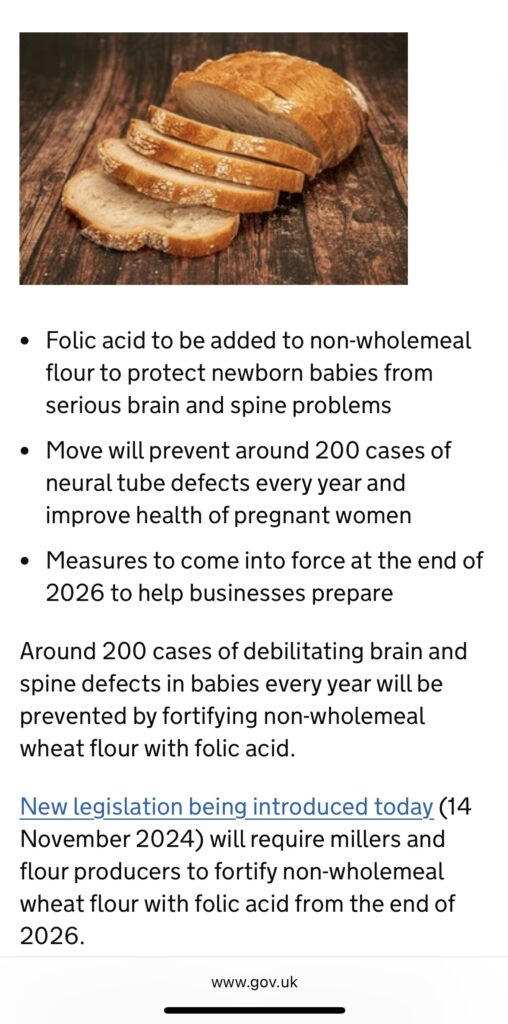
Whilst no normal thinking human being would ever want any baby to suffer an NTD, this situation should make normal thinking humans scratch their heads. It should be making the government and its advisors think again.
Neural tube defects
NTDs are birth defects of the brain, spine or spinal cord. This happens when the tube surrounding the central nervous system doesn’t close properly in the developing foetus. The closure of the tube should happen in the month following conception, often before the mother to be knows she is pregnant. The two most common neural tube defects are spina bifida, (meaning split spine) and anencephaly.
Folic acid
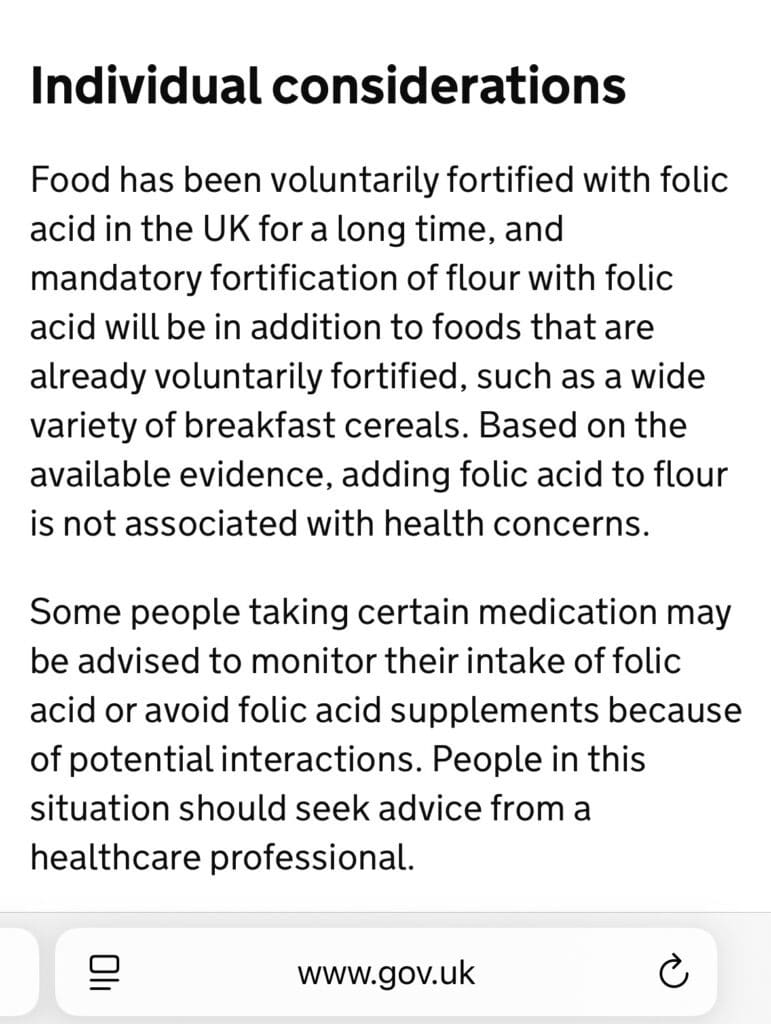
Even though some people seem to tolerate folic acid it is absolutely no good to me, nor to millions of others who should not be ingesting it despite what the government says:
“Based on the available evidence, adding folic acid to flour is not associated with health concerns.”
Whilst there’s no doubt that folate is essential to human life and will protect from NTD’s, synthetic folic acid is a different story for far too many people.
Who should steer clear of folic acid?
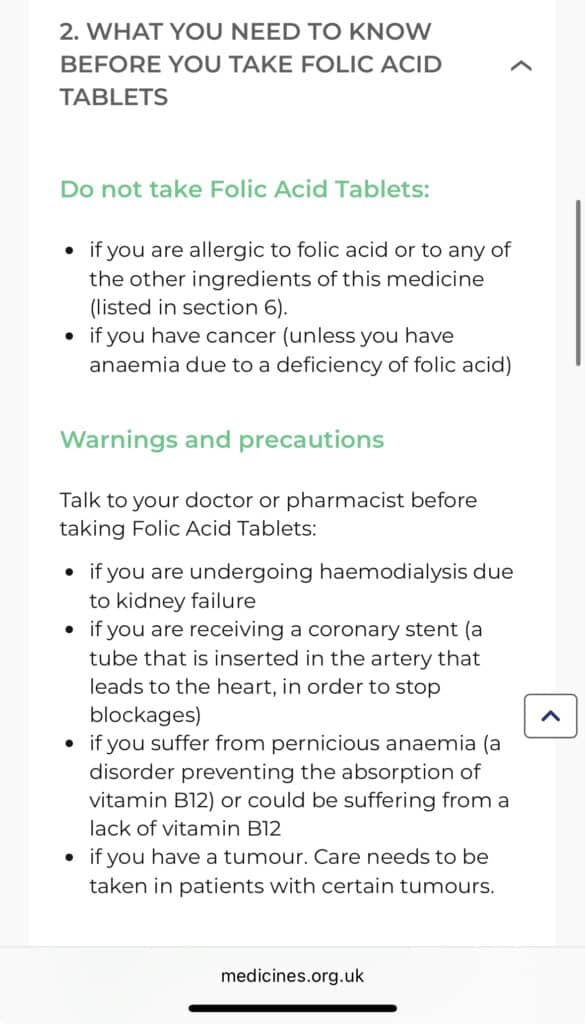
The following information details who should not take folic acid, it mentions the potential side effects and warnings about interactions with other drugs. This should make us realise that folic acid is not benign and safe to dump into our food.
Here’s some confusing information written by the NHS:
Who can and cannot take folic acid
Most adults and children over 12 months can take folic acid tablets or liquid on their own.
Multivitamins containing other vitamins combined with folic acid are not recommended for children under 12 years of age.
Folic acid tablets and liquid are not suitable for everyone. For example, they may not be suitable if:
- you’ve had an allergic reaction to folic acid or another ingredient used in the medicine in the past
- you have vitamin B12 deficiency anaemia or pernicious anaemia (a condition where your immune system attacks your body’s healthy cells)
- you have a coronary stent (a small metal mesh tube inserted into the artery that leads to your heart)
- you have cancer
Before taking folic acid tablets or liquid, tell your doctor if you have any medical conditions.
We can already see that there’ll be a problem for a good number of people if they are to be fed a synthetic medicine which they may be completely unaware of taking.
Let’s hazard a guess that more than 0.000289% of people in the UK have cancer, or have a coronary stent. Even if we leave out the people like me, with methylation issues who can’t tolerate it. This maths doesn’t make any sense at all.
The mention of vitamin B12 deficiency above applies to excess folic acid leading to a fall in vitamin B12 levels which can cause direct harms to the nervous system. This is quite a number to add to the sum of people who shouldn’t touch it.
It’s important to note that people on haemodialysis for kidney failure used to be warned against folic acid supplementation on the above NHS table but that has been removed. However it does still remain in the PIL (Patient information leaflet) for folic acid. So yet more numbers to be added to the growing list of those who Cannot take folic acid.
In the video interview by Zoë Harcombe with Dr Clare Craig, she explains that she submitted a FOI request to ask why the haemodialysis warning vanished from the NHS website, here’s an excerpt below:
Clare presents a compelling case that the folic acid mandate has many risks and harms for many people. It risks a dangerous mass medication precedent in the UK. It is likely already harming many people in the US. Perhaps most importantly, the rationale for the entire project may actually be harming many more babies than it claims to help. Nine pregnancy and stillbirth losses for every neural tube defect avoided.
The NHS goes on to say:
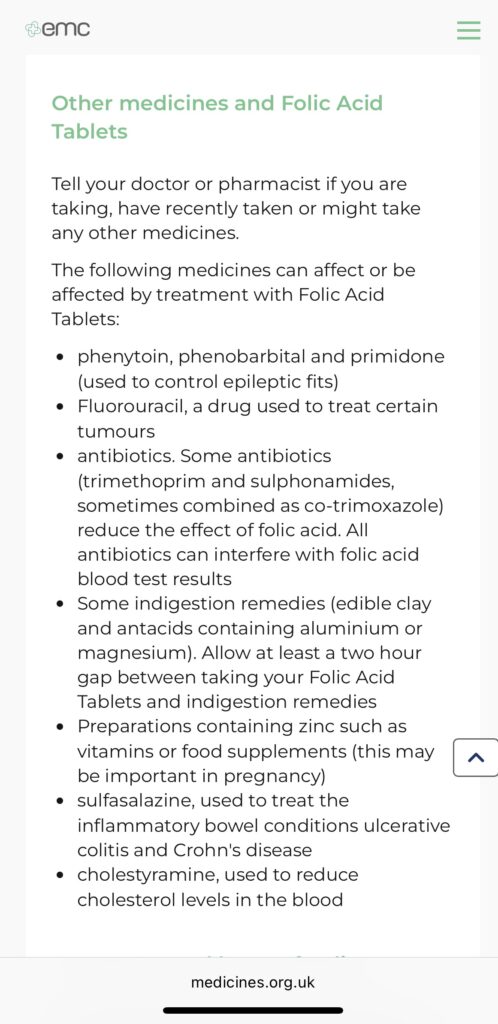
Taking folic acid with other medicines, herbal remedies and supplements
There are some medicines, remedies and supplements that may not mix well with folic acid tablets and liquid.
These can include:
- epilepsy medicines, such as phenytoin, phenobarbital and primidone
- antibiotics, such as chloramphenicol and co-trimoxazole
- sulfasalazine, which is a medicine used to treat ulcerative colitis, Crohn’s disease and rheumatoid arthritis
- lithium, a medicine used to treat mental health conditions
- aspirin used for pain relief or thinning your blood
Before taking folic acid tablets or liquid, tell your doctor if you’re taking any other medicines, herbal remedies, vitamins or supplements.
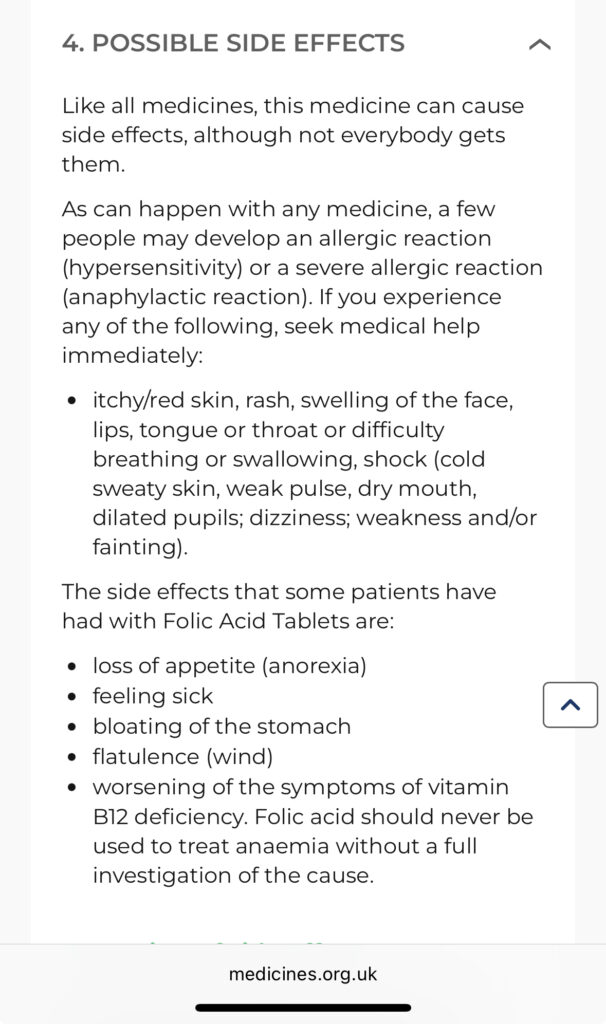
From the PIL Patient information leaflet you can see how folic acid is not a helpful substance for everyone…
Research papers
There are many, many paper’s on folate but I’m just going to focus on three today in the hope that you’re still awake for the rest of this blog.
ONE. Below we see an excerpt of Consultant Neurologist Edward H Reynolds 2025 abstract from just one of his papers on this subject; Folate, vitamin B12, one carbon metabolism and the nervous system: Excess folic acid is potentially harmful.
…In countries with folic acid fortification policies many subjects are exposed to excess folate. The long term genetic, epigenetic and transgenerational implications are yet to be clarified. The safe UL of folic acid should be reconsidered in relation to the vitamin B12 status of individuals and populations. The combination of a natural folate together with vitamin B12 would greatly improve the benefits and reduce the harms of current fortification policies.
TWO. The very detailed Fardous & Heydari paper below from 2023 (The featured image);
Uncovering the Hidden Dangers and Molecular Mechanisms of Excess Folate: A Narrative Review. Nutrients. helps us to understand more about the effects of folic acid as do its 248 references. I urge you to take a look.
Abstract
This review delves into the intricate relationship between excess folate (vitamin B9) intake, especially its synthetic form, namely, folic acid, and its implications on health and disease. While folate plays a pivotal role in the one-carbon cycle, which is essential for DNA synthesis, repair, and methylation, concerns arise about its excessive intake. The literature underscores potential deleterious effects, such as an increased risk of carcinogenesis; disruption in DNA methylation; and impacts on embryogenesis, pregnancy outcomes, neurodevelopment, and disease risk. Notably, these consequences stretch beyond the immediate effects, potentially influencing future generations through epigenetic reprogramming. The molecular mechanisms underlying these effects were examined, including altered one-carbon metabolism, the accumulation of unmetabolized folic acid, vitamin-B12-dependent mechanisms, altered methylation patterns, and interactions with critical receptors and signaling pathways. Furthermore, differences in the effects and mechanisms mediated by folic acid compared with natural folate are highlighted. Given the widespread folic acid supplementation, it is imperative to further research its optimal intake levels and the molecular pathways impacted by its excessive intake, ensuring the health and well-being of the global population.
Here’s the conclusion of this important paper:
8. Conclusions
As researchers, including ourselves, strive to unravel the conserved and intricate dynamics governing the relationship between folate, health, disease, and longevity, a crucial question arises: could exposing the human population to excessive levels of folate potentially accelerate aging and increase the risk of disease?The key to answering this question lies in identifying causal underlying mechanisms that can robustly link excess folate intake to the observed detrimental effects. Achieving this goal requires substantial research efforts and collaboration across multiple scientific disciplines to identify and address the existing knowledge gaps. The importance of pursuing such research cannot be overstated, as these gaps in knowledge may be unknowingly and insidiously compromising the health of hundreds of millions of people worldwide who are consuming excess folate.
THREE. Let’s take a look at the conclusions of this 2012 paper from;
Tomaszewski et al. Increased cancer cell proliferation in prostate cancer patients with high levels of serum folate.
CONCLUSIONS
Increased cancer cell proliferation in men with higher serum folate concentrations is consistent with an increase in prostate cancer incidence observed with folate supplementation. Unexpectedly, more than 25% of patients had serum folate levels greater than sixfold adequate. Nearly half of these men reported no supplement use, suggesting either altered folate metabolism and/or sustained consumption of folic acid from fortified foods. Prostate 71:1287–1293, 2011. © 2011 Wiley-Liss, Inc.
Prostate cancer is now the most common cancer diagnosed in the UK jumping to 64,000 cases in 2022.
The Blame game
The mass fortification of flour by the government tells us that, apparently, women of child bearing age can’t be trusted to eat enough folate rich foods. They then decided that every man, woman and child from December 2026 must take a medication hidden in flour to help these women to have a child without an NTD.
So, with all the focus seemingly on folate, if any new mum gives birth to a child who has an NTD or any birth defect, it’s very easy for the mum to blame herself. It also becomes even easier for society to blame her because;
A. Clearly she didn’t take a folic acid supplement
B. Clearly she doesn’t have a good diet and didn’t eat enough folate rich foods
The new one will be –
C. Clearly she didn’t eat enough floury baked goods
How often do mum’s feel enormous guilt about the problems of their child, what ever their state of health at birth or indeed throughout their lives? Being made to feel that the circumstances of their child’s health are entirely their fault is not a good way to begin motherhood.
Causes of NTD’s
Even though there are other causes of NTD’s, we’re being directed only to look in this one area and we’re not being encouraged to look anywhere else. In fact so many who are invested in folic acid fortification appear to be turning a blind eye.
The statement below is from the Shine charity – Campaigning for folic acid fortification
In November 2024, our campaign for mandatory fortification of flour became law at last!
Our CEO provided a quote for the official government press release:After more than 30 years of campaigning, Shine can finally celebrate the introduction of this very important public health initiative.This move will mean that far fewer families will have to undergo the trauma of a potentially fatal or life-affecting diagnosis for an unborn baby. This is a major milestone, and we are so grateful to everyone who has played a part in getting this legislation over the line”
What’s interesting to me about this charity is the quietness with which they talk about the harms from pharmaceuticals that cause NTD”s. Don’t they, as a charity supporting people with spina bifida owe it to their community to shout about all things NTD rather than just the one agenda the government is pushing?
This charity clearly provide support for those with Spina bifida and other NTD’s but what I would want to see should I have required their help and support, is a Causes page like the one I have on my site. – Because isn’t that the one question people have when all is not well? Why did this happen? What could have been done differently? What’s the root cause? How can we stop it happening to anyone else?
On their prevention page they state:
Folic for Life
Find out why everyone, especially women, need to know more about folic acid.We don’t know all the causes of spina bifida and anencephaly, but there are some ways to reduce your chances of an NTD-affected pregnancy. This section contains important information and an opportunity to join our campaign for the mandatory fortification of flour with folic acid, an initiative proven to significantly reduce NTDs in more than 80 countries across the world.
Lowering the chances
Epilepsy
If you take anti-epilepsy medicine, make an appointment to see your neurologist well before you start trying for a baby. Some medicines, such as sodium valproate, are associated with NTD and other birth problems, so check that you are on medicines with a lower risk. If your neurologist agrees you need to change medicines, it could take several months to do so safely. Your health and wellbeing are the most important factors in this change.
And another small piece of information from the search for Sodium Valproate on their site From this page: Pregnancy in women with spina bifida. Note that there’s no mention bipolar or migraine which are the other uses for sodium valproate.
Epilepsy
If you take epilepsy medication, let your neurologist know. Some epilepsy medication, such as sodium valproate are associated with several health problems in babies, and you may be advised to change medication. This would need to be done gradually, under close supervision to make sure your epilepsy is well controlled, and this can take many months to do safely. Your medication dose may need to be changed during pregnancy, as your blood volume increases.
Epilepsy
So we now know that drugs for Epilepsy can be harmful to the unborn child, the most commonly used in this group of drugs is sodium valproate, which can also be prescribed for migraine and bipolar disorder.
Sodium valproate causes NTD’s and other birth defects
This BBC London clip titled A drug used during pregnancy could cause birth defects for generations – BBC London News
It details that the government and doctors knew back in the 70’s that it was extremely harmful in pregnancy but that at the time it was for the doctors to decide how much information was given to the patient. Mind blowing.
Teratogens
A teratogen is anything you’re exposed to or ingest during pregnancy that’s known to cause foetal abnormalities. Drugs, medicine, chemicals, certain infections and toxic substances are examples of teratogens.
Take a look at this UK Teratology information Service website if you are pregnant or thinking about having a family and are concerned about medical and chemical exposure during pregnancy and here for epilepsy in pregnancy.
Here’s what they say about the use of Sodium Valproate in pregnancy
Valproate is also a neurobehavioural teratogen that has adverse effects on features, including offspring IQ and motor skills. Data suggest that the likelihood of autism spectrum disorder may be up to three-fold increased following prenatal valproate exposure, compared to the ~1% incidence in the background population. Studies have noted that between 19% and 62% of valproate-exposed children require additional educational support. Individuals with neurodevelopmental disorders caused by prenatal valproate exposure may not exhibit overt structural anomalies.
This American site The Birth Injury Help Center will help a mother to be to navigate medicines and the effects that they can have on birth defects. You might also be interested in this Critical appraisal on neural tube defects and their complexities. Pediatrics & Neonatology
Campaigns
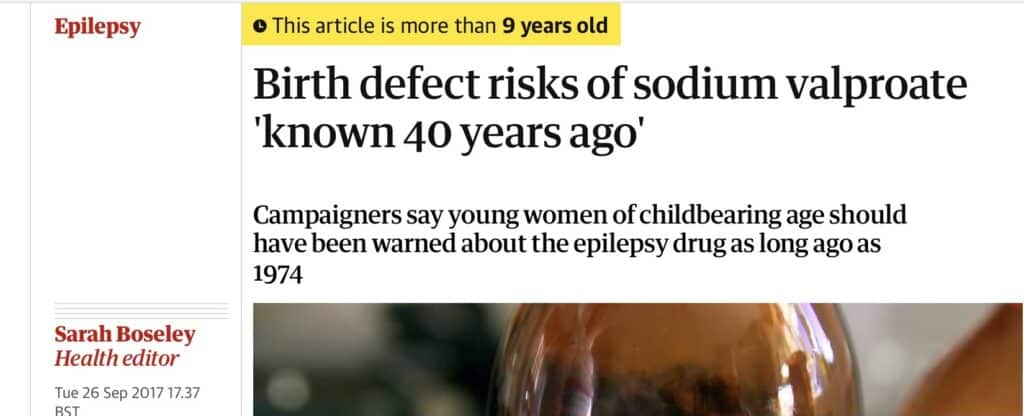
Birth defect risks of sodium valproate ‘known 40 years ago‘ Campaigners say young women of childbearing age should have been warned about the epilepsy drug as long ago as 1974. Please see the article written by Sarah Boseley in 2017…
___________________________________________
And this …BBC News article .. Mum’s 20-year fight for epilepsy drug compensation
It is thought thousands of children in the UK have been left with disabilities caused by valproate since the 1970s.
Instructions for doctors – and, more recently, patient leaflets – say valproate should not be used during pregnancy unless there is no safer alternative and only after a careful discussion of the risks.
Before undergoing fertility treatment, Mrs Cox was advised it was “fine” to continue taking valproate.
“To then find out that the medication that you have taken in good faith has caused the problems your child will carry for the whole of their life is an awful thing,” she told the BBC.
Mr Cox has a job at a local bakery but relies heavily on his mother.
“It can be a struggle at times,” he said. “I do worry at times but I also worry about my mum. Obviously I love my mum.”
Mrs Cox told the BBC she had grown weary of a lack of action from successive governments.
“We’re not getting any younger. I started this when I was 31 – I’m 53 this year,” she said.
“I honestly think that the government want the parents to expire, because the children will not be able to fight for the redress that they need.”
Because the government has passed the buck, your route to compensation is via the NHS – please see:the following from Resolution NHS – sodium-valproate.
What is Sodium Valproate?
Sodium Valproate, commonly known by brand names including Epilim, Episenta and Depakote is licensed in the UK to treat epilepsy and bipolar disorder. It is also occasionally used to treat migraines. Sodium Valproate is an essential medicine for men and women who suffer from epilepsy and for whom other treatments might not be effective.
When was it used to treat Epilepsy?
It was first licensed to treat epilepsy in the UK in 1972. At that time it was known to be teratogenic (harmful to a developing fetus) in animals. There were also concerns about the teratogenicity of other anti-epileptic drugs during this period. .
For some women, including those of childbearing potential, Sodium Valproate may be the only effective treatment for their epilepsy. Sodium Valproate is very strongly contra-indicated for women of childbearing potential and they must only be prescribed valproate if a Pregnancy Prevention Programme (PPP) is in place. The PPP includes the use of a highly effective contraception and an annual review by a specialist, ensuring that the patient is fully advised of the risks to their unborn child should they become pregnant.
“First do no harm” – The Independent Medicines and Medical Devices Safety Review
As a result of concerns raised by a number of women and children who were concerned that exposure to Sodium Valproate in utero had caused damage and that there had been no or an inadequate warning of the associated risks, the (then) Secretary of State for Health and Social Care, Jeremy Hunt MP, announced a review into Sodium Valproate. The review was led by Baroness Julia Cumberlege and the report of the Independent Medicines and Medical Devices Safety (IMMDS) “First Do No Harm” can be read here.
The Government published its response to the IMMDS Review in July 2021.
Epilepsy.org.uk have some helpful information for you if you are thinking of starting a family.
Bipolar
Some readers of this blog might be interested in, especially if you were formerly and erroneously diagnosed with bipolar rather than vitamin B12 deficiency.
The below information is taken from the Bipolar UK website https://www.bipolaruk.org/about-bipolar/treatment/sodium-valproate/
It has been known since the 1990s that valproate has a risk of harming unborn babies. In 2019, the UK imposed a ban on prescribing valproate for any female under the age of 55, unless there were very specific reasons for doing so.
In 2024, guidelines were released about men under the age of 55 taking valproate. More recent data suggests there may not be a problem with valproate in men after all. We are waiting for the authorities to issue new guidelines.
https://www.medicines.org.uk/emc/product/1496/pil
If you are a woman aged under 55 years who is able to have a baby, you must not take Sodium Valproate Tablets unless two specialists have agreed that your condition does not respond to other treatments and the benefit of the treatment outweigh the risks and you use an effective method of birth control (contraception) at all times during your entire treatment with Sodium Valproate Tablets. Do not stop taking Sodium Valproate Tablets or your contraception until you have discussed this with your specialist. Your specialist will advise you further (see below under “Pregnancy, breast-feeding and fertility – Important advice for women”).
As we know, the harms of sodium valproate have actually been known about since 1974 but that has not really alarmed those who should be interested much at all until recent years. Sadly as you have read the government still does not give two hoots about the harm to the children affected.
MTHFR and methylation issues.
One last point I want to make, you’ll have read a little about this issue in the paper abstract I shared.
I am one of the millions of people in the world affected by methylation issues, in particular MTHFR variants. Many of us find folic acid intolerable so the statements made here on the Shine Charity website are not helpful and do not reflect the lived experience of far too many people.
…Shine has taken guidance from one of the world’s leading experts in this field, Prof Anne Molloy. This is a summary of her advice.
- The MTHFR gene variants are common and there is no need to be tested
- The MTHFR 677C>T variant may work less well at low blood folate levels than the more common MTHFR form
BUT
- Folic acid will raise your blood folate levels whatever variant you have
- Raising your blood folate level will help prevent your pregnancy being affected by Neural Tube Defect (NTD)
- Folic acid is safe whatever variant you have and has been proved to reduce the chance of your pregnancy being affected by NTD
Folic acid does me no good at all. The most noticeable effect for me was how poor my memory became when I took it, but others with methylation issues may experience a range of harmful side effects. Thirteen years ago I stripped folic acid out of any supplement I took and switched to a bioavailable form. That proved to be an absolute game changer for me.
So what do you think, should we be adding folic acid to flour, or is there a better way?
All the very best
Tracey
www.b12info.com
0 Comments