

Here we go again…
This blog discusses how the NHS North East and Cumbria think 12,500 people have been given B12 injections without needing them! There are many times I hold my head in my hands at the ridiculous things said about B12 deficiency. Some of them are hilarious, for example:
A member of staff in a well known British high street health food shop telling a customer that she could just take two B6’s as there were no B12 supplements in stock.
Or the GP telling me that he was treating the B12 deficient patient ‘holistically’ by giving her antidepressants instead of B12 injections.
And my mum’s GP to whom I explained why mum still needed injections during a good twenty minute appointment, only for him to ask right at the end, why can’t she just have tablets?
We know better than NICE …
It may be that you, dear reader, experience some wild things at your GP Surgery. Some doctors and nurses state about NICE – They’re only Guidelines, we don’t have to follow them. We have our own protocol. Then they’ll proudly show you that they spread the loading dose over six weeks rather than the two it should be, thereby prolonging your agony. And, for example the Leicestershire Formulary think patients should be given B12 injections every 3-4 months, what a bizarre move?
Let’s hope your GP is wise enough not to follow this madness.
So here’s some more ‘amusing’ – writings from the NHS in the North East and North Cumbria dated 9th October 2026. (Oops, it seems the above link no longer goes to this article so I add the screen shots throughout this blog. Let’s hope that the article has gone because it was a ridiculous idea.)
Here’s the snappy title:
Thousands to be offered simpler alternative to B12 injections under new NHS guidance (Perhaps It should read – Apparently GP’s have misdiagnosed 12,500 people!)
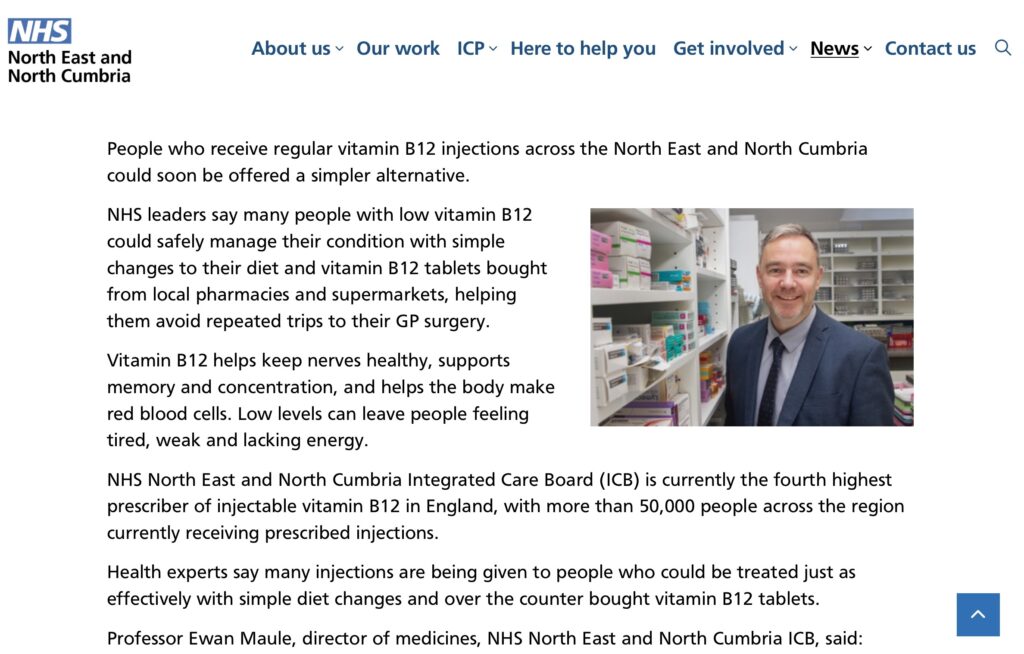
Look at the positivity with which this news is delivered and then they tell us how important B12 is. We then find out that this ICB apparently gives B12 injections out willy nilly (around 12,500 per year too many) and what these fabulous experts think:
Prof. Maule then makes a statement that most of us with B12 deficiency have heard before:
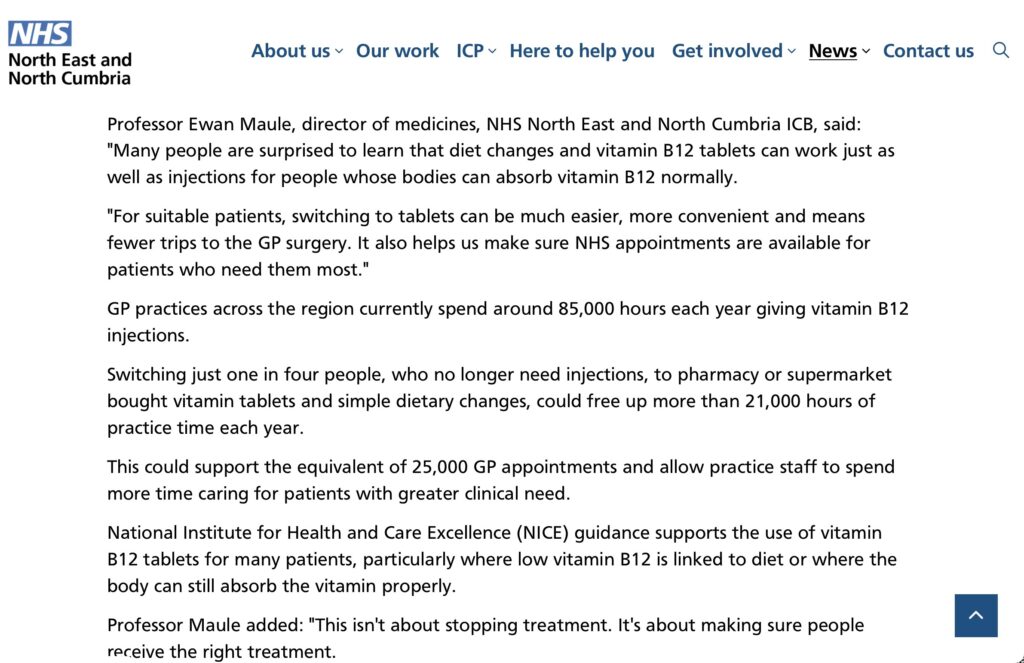
Of course people would be surprised that a GP was giving B12 injections to people who didn’t need them. The problem is that most B12 deficient patients have had to fight tooth and nail to access B12 injections. It’s easier to get blood out of a stone or to find a needle in a haystack for the vast majority of patients. So how people who have absolutely no absorption issues at all, are prescribed them is anyone’s guess. Far too many people when they are diagnosed with B12 deficiency are not given injections, they are told to buy a supplement and come and see us in three months.
The serum B12 level will raise however this does not mean recovery or symptom improvement. It’s just a number on a piece of paper. GP’s forget, or don’t know that the tablet takes the same route as food, so if one doesn’t work, why on earth would the other?
Many people I work with are not asked if they eat animal products when they are refused B12 injections. Most people I work with do eat animal products, so asking them that one question alone should tell the GP that there’s definitely absorption issues afoot. Many people who choose not to include animal products are not miraculously exempt from all of the other causes of B12 deficiency so it would be foolish to say to an extremely B12 deficient patient – off you pop, just change your diet and go and take a couple of B12 tablets, without exploring possible causes further.
Any doctor faced with a really poorly patient even if it was PROVEN to be due to dietary lack, surely would take the kindest and most appropriate action and give B12 injections until their stores were replete. Only after then, the patient should supplement with a good B12 tablet if there’s no dietary change.
Injections are for life
No one I know relishes the thought of having B12 injections for life and they certainly don’t want more injections than they need. It’s just that they happen to be a life saving, essential and they simply become a regular stinging part of life. If there really were a tablet we could all take that would heal our nerves and rebuild our myelin sheath then why would any of us choose the injections?
The fact remains that B12 injections are the most efficient, effective and inexpensive means of us staying well. Here’s the comical maths the NHS has used to tell us what vast savings this mad move will make:
GP practices across the region currently spend around 85,000 hours each year giving vitamin B12 injections. Switching just one in four people, who no longer need injections, to pharmacy or supermarket bought vitamin tablets and simple dietary changes, could free up more than 21,000 hours of practice time each year. This could support the equivalent of 25,000 GP appointments and allow practice staff to spend more time caring for patients with greater clinical need.
Let’s do some simple maths too.
They’ve told us that over 50,000 people have B12 injections in this area. So we’ll keep that at 50,000. At a conservative estimate, most of these poor souls will probably only be having four injections a year, so around 200,000 injections potentially being given. (For the sake of this exercise we’ll imagine none are having loading doses).
They’ve stated they spend 85,000 hours a year giving injections, and that’s usually nurses and not GP’s giving them. If we’re generous and give ten minutes per injection, (even though it takes less than a minute to break the ampoule, draw up the B12 and inject), that gives us 510,000 injections given a year, making that 10.2 injections per year for each patient. I think we can hazard a guess that that’s highly unlikely. I don’t know how long these appointments and injections are taking in reality, but it appears to be a gross over estimation of ‘hours spent’.
Unless those 85,000 hours are due to a YTS doing the job, someone seriously needs to rub that maths out and start again. To be clear, many B12 deficient patients are not seeing the GP regarding B12 deficiency once they’re on treatment. So why would exactly they be saving the equivalent of 25,000 GP appointments a year?
Here’s what should be happening, IF THE GP IS FULLY AWARE of B12 deficiency and its complex nature. I think we should assume that everyone in this geographic area currently receiving B12 injections was probably below range on a serum B12 test. We can safely assume that because it’s virtually impossible to access them if you’re within range. The GP should then ask the correct questions once B12 deficiency has been identified – or even at the first appointment before it’s even tested:
What are your symptoms?
Do you eat animal products?
Do you have a family history, if so, do they know the root cause of their deficiency?
Do any of these causes strike a chord with you?
Having asked these essential questions then they should fully explore the potential causes, are they on metformin, acid suppressants, could they have PA, have they had a particular surgery, do they have H Pylori, SIBO? Could they have parasites competing for their B12?
Self injection
Once it’s established that there’s a temporary or ongoing need for B12 injections, why not ask the patient if they’d like to self inject after being taught how to do it? Now that would be a saving wouldn’t it? Literally thousands of hours!
Letting the patient be in charge of their own injections, like children with insulin can be – wow, what a revelation for the GP Practices in the North??
Of course some elderly people would still opt for a district nurse to visit and give them that essential B12 injection and that visit would be hopefully for more than just ‘jab and go’. Hopefully that visit would include a little chat and maybe checking on other things that might be going on for them, like the old days when people had time to care.
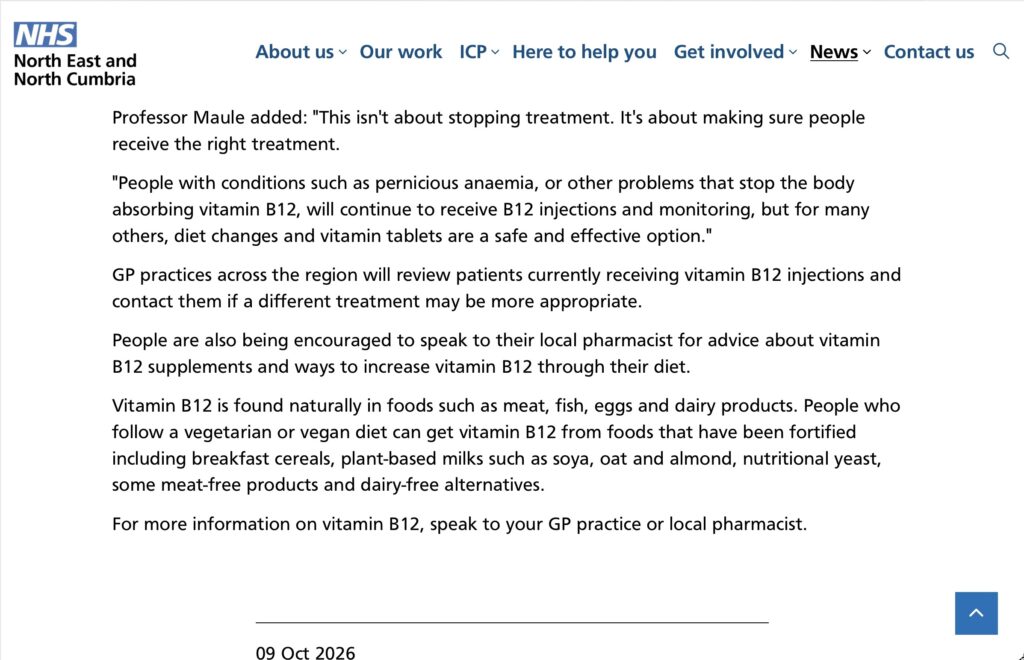
Let’s hope it isn’t about Stopping treatment again.
Do you remember during the lockdowns when patient’s were told they could suddenly absorb B12 from tablets without any consultation whatsoever and the BSH had to back track?
So how exactly is this review going to happen?
Will it be someone sat behind a desk telling everyone whose surname begins with T that they can suddenly absorb from tablets? Those who have positive intrinsic factor tests should be safe and be able to keep their lifesaving injections, but how do they check the other patients?
If they know the patient is a vegan they still need to check for other causes. How do they know if the problem is methylation issues? Some people never find the root cause of their deficiency, they just know they can get out of bed and think straight when they have their injection.
They end the article by telling us where B12 is found and include some nasty highly processed additive filled choices. It seems to imply that the 12,500 people who will have B12 injections stopped will be those who have a dietary lack, however this begs the question – shouldn’t this have been managed in the beginning?
If anyone is being given B12 injections they don’t need I’m sure they’d be glad to be relieved of them. The problem comes when mistakes are made and people are left without their life saving B12.
We’ll have to wait and see how this pans out. If you live in this area, or another where this might follow, let me know what you think. I’d love to hear from you.
I sincerely hope you have a GP that uses their own critical thinking and that if you are called in and suddenly told that you can use tablets instead of having your life saving injection, that you stand firm and let them know how ridiculous the situation is.
Please get in touch if you’d like my help.
All the very best Tracey www.b12info.com
P.S. The image is of our Poster boy Jasper, looking over Cat Bells in Cumbria.
Another excellent blog again Tracey